About Us

Smt. Kalyani Krishnaswamy was born on June 22nd, 1930, in the historic town of Thiruvalangadu, located in rural Tamil Nādu. She often mentions how privileged she has felt, hailing from this lovely town renowned for its proximity to Kumbakonam and Mayiladuthurai (also called Mayuram). She was apparently the only one from her large family who was born here. This was also located near the sacred town of Sirkali, from which my father and her husband, Dr. N. Krishnaswamy, hailed. My mother had a deep love for Tamizh and for the classic music system of South India, often referred to as Carnatic music. As a child, she learned both vocal and instrumental music, with her musical adventures leading her to the Veen legend, Karaikudi Sambasiva Iyer. However, as parental duties and other responsibilities consumed her, she had to give up pursuing music as a career. Her interests in music and the arts were supported by her physician husband, who took a personal interest in her holistic development, even teaching her to drive a car when she was in her early thirties. Furthermore, due to her abiding interest in music, she concentrated on exposing her three daughters to the best of the arts and education, often driving them to their music and dance classes.

It was, however, during her trips to the United States that she started using her afternoons to compose songs in Tamizh and Sanskrit. One of her early Sanskrit compositions, Eshwari Jagadeeshwari, which she set in ragam Yamuna Kalyani, is loaded with swaraksharas. The words such as “Maheshwari Mama Hridaya Vasini, Parameshwari, Patitha Pavani Ragini”, use the swaraksharas for Ma and Pa swaras and came easily to her mind and lips. She subsequently composed Parvathiputra, a song dedicated to Ganesha, the older son of Parvathi and Shiva, which she set to the auspicious morning ragam, Bowli, a janya of the melakartha ragam, Mayamalavagowla. Selected words used in this composition include, “Parvathi Putra, Parama Pavithra, Gananayaka, Sharanam”. This too has the swaraksharas involving the swaras Pa and Ga, considered pivotal to the flavour of Bowli.

Since the early 1970s, my mother has composed close to sixty krithis, (a few are yet to be set to tune), dedicated to the deities Murugan, Ganesha, Krishna, Saraswathy, Lakshmi and Kamakshi, the last being her favoured or Iṣhṭa-devatā. Her songs have been sung by Smt. S. Sowmya, Sri Neyveli Santhanagopalan, the Carnatica Brothers, Mambalam Sisters, Sri Sikkil Gurucharan, Sri Suryaprakash, Smt. Gayathri Girish, Smt. Gayathri Venkaraghavan, Smt. Anajana Thirumalai, Smt. Sriranjani Santhanagopalan, Smt. Deepika, and Sri Sankaran Namboothiry, to name a few. She would often sing these songs to my sister, Kala, on the phone and sometimes to me or my other
siblings, Geeta and Girija. She chose the ragam and often fixed the sangathis and nuances of the songs, which were then improvised by creative and talented musicians. The talam often fell into place, with minimal alterations. Some senior musicians have often commented on the sudden changes in rhythm, cadence, and “nadai” that characterized some of her compositions. For inspiration, my mother has often talked about the influence composers such as Sri Subramania Bharati, Sri Papanasam Sivan, Andal, Sri Muthuswamy Dikshitar and Sri Thyagaraja had on her during her youth.

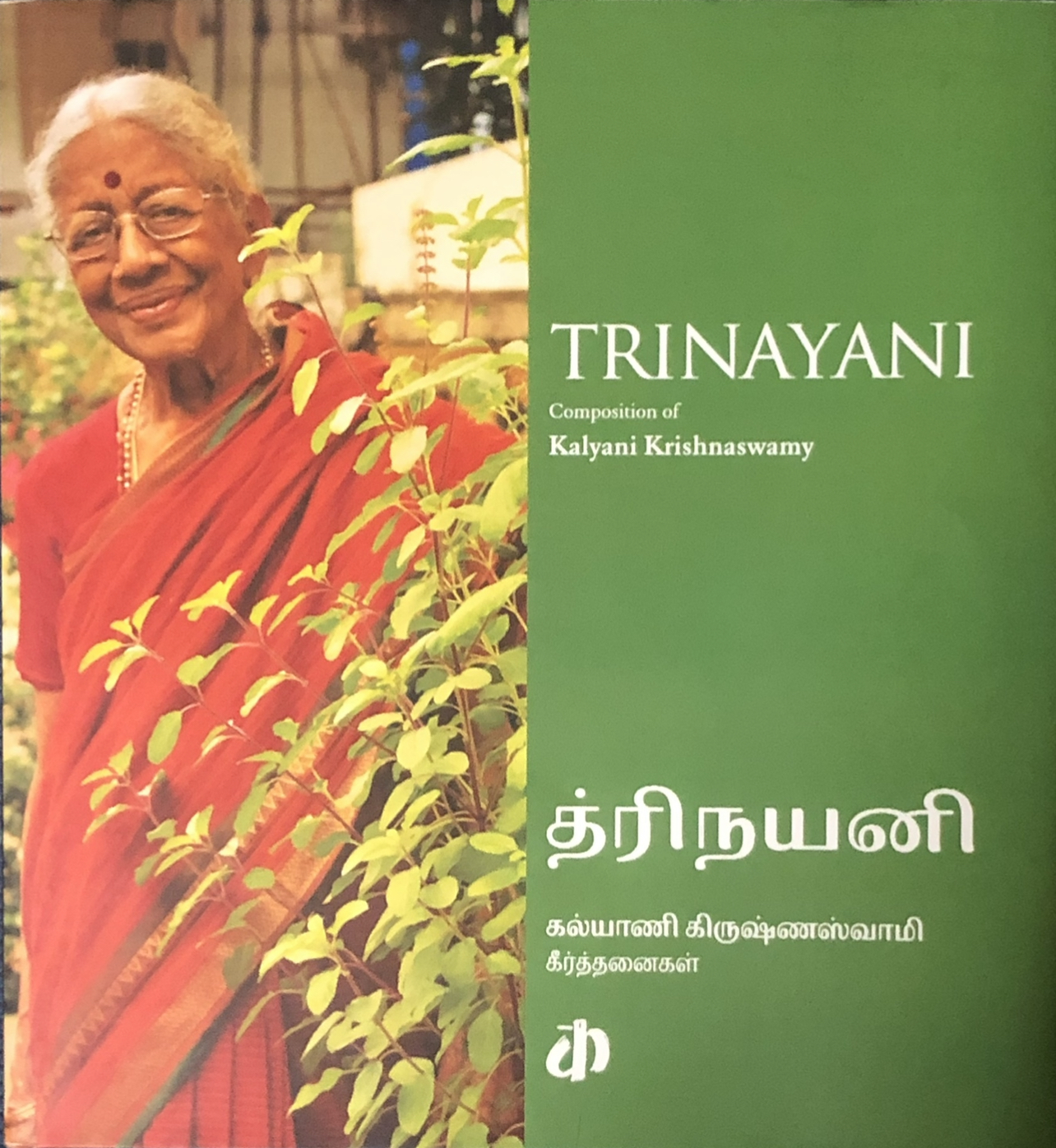
Her songs have also been professionally recorded under the Carnatica label and a four-volume CD, “Naad Anunaad”, was released a few years ago. For this, we owe Sri K.N. Shashikiran, director of Carnatica, for his zeal, passion and one-minded dedication to bringing out her music. Her compositions have been gathered in a book, “Trinayani: Compositions of Smt. Kalyani Krishnaswamy”, published by “Katha”, an iconic organization run by my sister, Smt. Geeta Dharmarajan. More recently, with the help of Smt. Anjana Thirumalai, the songs have been notated, leading to the publication of the present book, Trinayani-2.

Most musicians who have performed her songs have expressed admiration for the purity of her devotion and the profound use of the Tamizh language, simple words leading to the generation of guileless bhakti. In the song Sri Kamakshi, set to Todi ragam, my mother uses the words “Sarvaloka Rakshaki, Sarveshwari”, which besides being swaraksharas, also represent the deep spiritual ideas of timelessness and immanence. In the composition “Unnainindhalaum Sukhame”, set to the ragam Mayamalavagowla, she uses the words, “arpa sugamalla un divya nāmam kāṇal neeralla un pēraruḷ”. She states this refers to the absolute reality of the mother Goddess, who represents Sankaras ideas of Brahmasatyam, Jaganmithya. Thus, Kamakshi represents absolute truth, unlike the mirage-like existence of our worldly, mortal life. In the song Piravavarm tharuvaya, Dharaniyil”, set to the ragam Purvikalyani, she uses the words “Shattam All, Ivulagu Vazhvil Endru”, meaning nothing is certain in this life, and mortal life is engulfed by the spectre of impermanence. In contrast, to my mother, Kamakshi represents an oasis of security in the mirage-laden world of samsara. Her other songs also represent pivotal concepts, and the lines often appreciated by senior vidwans, occur in the song, “Devi Sri Devi”, set to Saveri ragam. Here, Smt. Kalyani Krishnaswamy uses the pivotal phrase, “en kurai un seviyil vizhavillayō?!, nee oru silaiyō?! darisanam tara manam illayō?! idu enna nyāyamō?! tanjam endru vanda ennai taḷḷalāmō?!” The words refer to the composer accusing the goddess of responding to her entreaties with a “stony silence”.